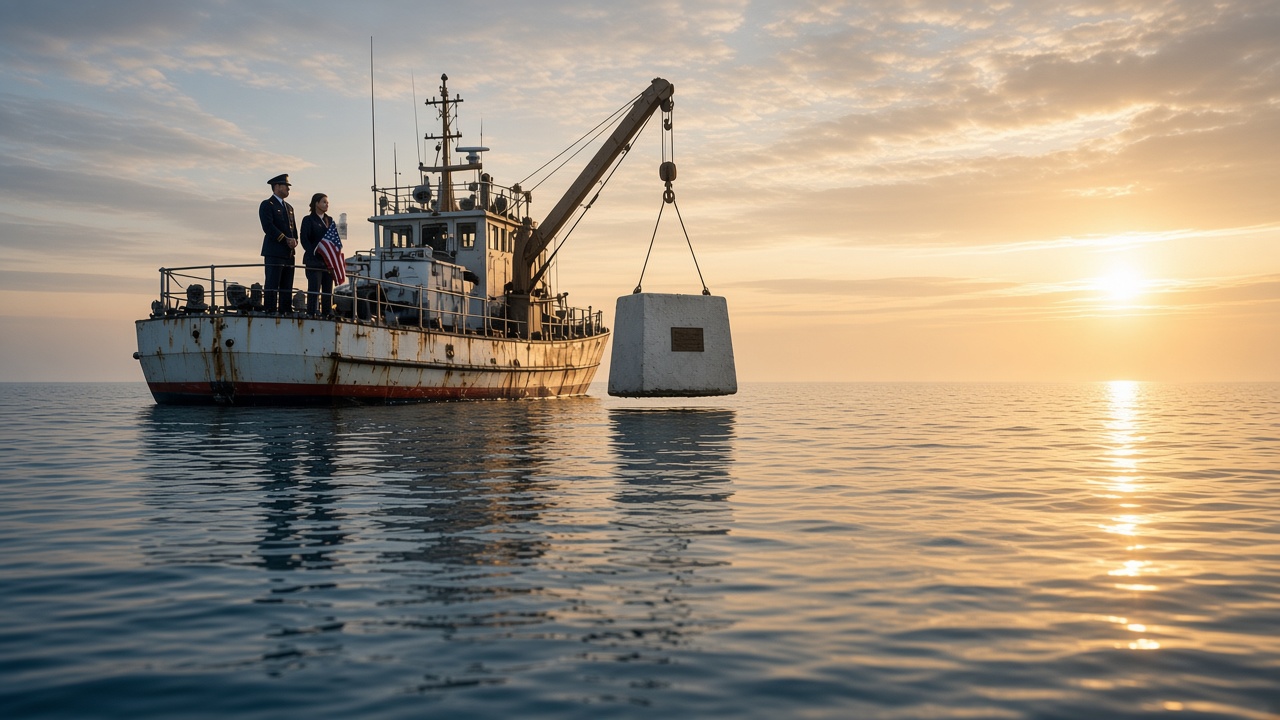
A local nonprofit based in Carolina Beach, North Carolina, has created an innovative new way to honor veterans of the US Armed Forces, with the establishment of Veterans Memorial Reef. The reef is an approximately 162-acre site consisting of large concrete memorial markers, where the cremated remains of veteran service members are placed.
The artificial reef is known as AR-372 and is located around 5 miles offshore. “For locals who have fished this area, the site is known as five mile boxcars,” said Thomas Marcinowski, founder of the Veterans Memorial Reef nonprofit organization. “This is because some train boxcars were dropped out there many years ago.”
Now, the site is being used as a home for specially crafted, ocean-friendly memorial markers, so the veterans can continue in their service to the country by protecting the coastline, as well as by providing a habitat for marine life. “The urns become a part of the existing ocean reefs and create a habitat for fish and sea creatures,” said Marcinowski.
A veteran of the US Army, Marcinowski established the nonprofit in response to the fact that Federal cemeteries are running out of space. He pointed out that cemeteries also represent an ongoing cost for the government, as there is a need to pay for electricity to keep the lights on and a groundskeeper for property maintenance.
“This is why we say this is an eco-friendly, economical alternative,” added Marcinowski. “Once the veterans are placed out there, they’re there for eternity, there’s nothing else to do or to worry about. That’s why our motto is, ‘Those who served continue to serve.’”
Marcinowski recently hosted the organization’s third annual Fallen Heroes Ceremony at the USS North Carolina Battleship Park, to commemorate the placement of five more local veterans on the reef. This year, the ceremony and the placement of the aquatic memorial urns is coinciding with the retirement of the US Coast Guard inland buoy tender Bayberry, a vessel that was commissioned in 1954.
The Bayberry will be dropping the urns in the water at Veterans Memorial Reef, in what will be its final mission. “The crew and the commander in chief are very excited about doing this,” said Marcinowski.
The Bayberry will then be transported to the US Coast Guard sector field office at Fort Macon, where it will be decommissioned.
After the urns are dropped in the water, divers re-orient the urns to face in an eastwardly direction. “Nine of the existing urns have already been repositioned by the Marine Special Operations Dive Team out of Camp Lejeune,” noted Marcinowski. “The purpose of having the markers face east is so that the sun rises on the veterans every morning.”
The markers are located 52 feet underwater and are unlikely to move. Each plaque includes the veteran’s name and other information similar to a burial marker, but Marcinowski has taken it a step further by including a serial number that corresponds to an online database. This allows for friends and family members to find the location through GPS markers.
The website also has an accordion page for each veteran, so that anyone who is interested can click on the veteran’s name and instantly read their biography, see photos and find information about their awards and distinctions, if applicable. “One of my goals is education,” said Marcinowski. “From an educational standpoint, if you click on the award, it gives you a link to a description of the award and why the veteran would have earned it.”
The other component of the educational mission is to promote the concept to the National Cemetery Administration and institutions of higher learning. “We’re teaming up with UNCW Marine Science students and they’re going to study the reef to see how it impacts the ecosystem, how we are affecting the coast and how we can to make it better,” added Marcinowski.
Artificial reef technology has already been proven effective in terms of its ability to protect the coastline, at the Brunswick Town historic site. As discussed in a previous issue, the historic site and its Colonial-era wharves were at risk from constant tidal forces and dynamic wave action. Important historical artifacts were being washed into the Cape Fear River, and the erosion was destroying valuable coastal resources.
Scenic Consulting Group installed 220 feet of ‘Reefmaker’ at Brunswick Town, a living shoreline wave attenuation system built from concrete, along the area with the highest erosion. The second phase installed an additional 240 feet, just before Hurricane Florence in 2018. Since then, many have noticed a variety of organisms thriving in the new habitat, from river otters, fish and seabirds, to oysters, crabs and shoreline marsh grasses.
The North Carolina Division of Marine Fisheries (NCDMF) currently maintains a network of 42 artificial reefs in the ocean and 22 in the state’s estuaries. The stated purpose is to provide a spawning and foraging habitat for many species of fish and to establish oyster sanctuaries.
Another goal is to compensate for the previous destruction of coastal habitats and the reduction of water quality. A side benefit is that the artificial reefs program has caused recreational SCUBA diving in North Carolina to expand significantly in recent years.
Part of the reason that North Carolina has become a destination for divers is the NCDMF used a variety of old boats to build the reefs. Since the scuttled vessels consist of everything from trawlers and fishing boats, to barges, dredgers and sailboats, even a few old Navy ships that saw action in WWII, the Korean War and the Cuban Missile Crisis, there are many areas of interest.
Tourism and the military are essential to the economy of the Cape Fear and the state of North Carolina. Tourism depends on the health and stability of the environment, yet increasingly, effectively protecting it is requiring innovation and creativity. Veterans Memorial Reef stands at the intersection of all of these ideas, making it a viable paradigm for the future.
As the saying goes, ‘All gave some, some gave all.’ It refers to the many sacrifices our veterans have made in service to the country, regardless of whether they lost their lives in battle. For the most part, these men and women were volunteers. If presented with the choice of either spending eternity in a graveyard while becoming an ongoing cost for the government, or protecting the coastline while serving as a home for marine life, it’s easy to imagine which path most veterans would choose.