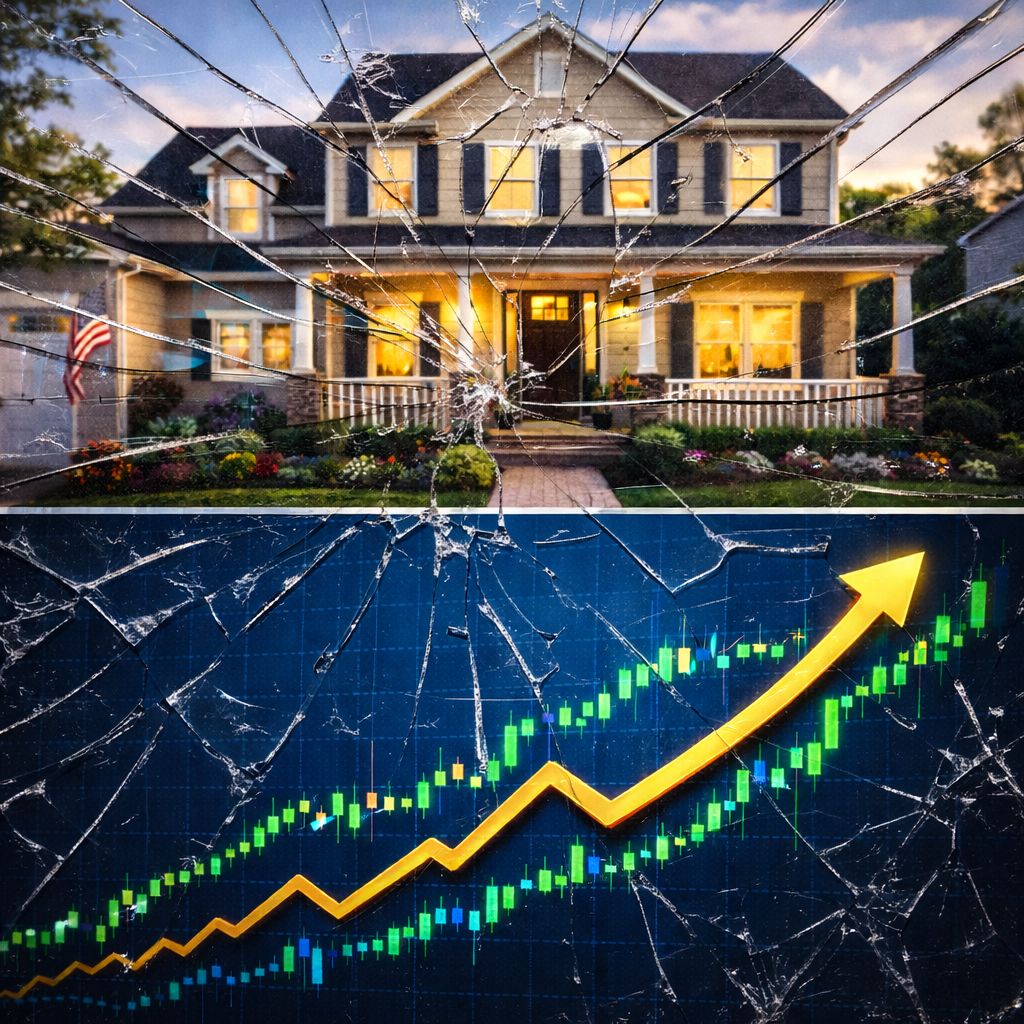
The Similarities Nobody Talks About
It may sound simplistic, but real estate and stock transactions both require a buyer and a seller. Both involve an opinion of value that may or may not be accurate. And in both markets, the gap between what something appears to be worth and the actual value can be shockingly, devastatingly significant.
Evaluating a house before making an offer takes effort, similar to assessing the value of a business before buying the stock. Many homeowners can describe the unknowns that can drastically alter the return on investment.
That house you fell in love with might just be a pig wearing lipstick. The financial statements of a business might be hiding the same thing.
There is paint specifically designed to cover up a ceiling leak. Similarly, there are a long tradition of creative accounting techniques that can make a terrible business look attractive (think Enron).
The question in both markets is the same: how do you know when it’s time to act, and when it’s time to wait? Exercising the wait and see approach is harder than it sounds.
The Worst House in the Best Neighborhood
This idea is repeated so often it has achieved the status of gospel: buy the worst house in the best neighborhood. The logic is sound in theory. The neighborhood sets the ceiling on value. Buy low, renovate, sell high.
I bought that house.
It looked like a value. It was priced below the comps. The neighborhood had a good reputation. Everything seemed to be in place.
What followed was two years of troubleshooting problems I could not have anticipated. There was always something…behind the wall…under the floor…and in the crawl space (OMG the crawl space! I’m having nightmares). The house was maintained the way some companies cook the books—just enough to pass inspection.
I spent two years doing nothing but working on that property. Two years of weekends, evenings, and stretches of time I cannot get back. My daughter was young. That is the part I think about most.
The worst house in the best neighborhood is still the worst house. Due diligence does not always save you, but skipping it guarantees you find out the hard way.
The research tools below would not have caught everything. Some problems are behind walls. But they would have helped me ask better questions before I committed—and asking better questions is most of what separates good decisions from expensive ones.
How I Research Real Estate Before Buying
Taking the time to kick the tires is always worth it. Along with hiring a qualified property inspector, these are the services I rely on for real estate research:
• Zillow Research — Their Housing Data library is useful for tracking local market heat and rental demand trends over time. Good for understanding whether a market is heating up or cooling off before committing.
• Redfin Estimate — A solid free starting point for a data-driven opinion on a home's current market value. Not a substitute for an appraisal, but useful for initial screening.
• Realtor.com Data — Particularly good for neighborhood-level inventory and sold-price history. Useful for understanding what comparable properties actually traded for, not just what sellers are asking.
How I Research Stocks Before Buying
For stock research I use three platforms, each serving a different purpose:
• Schwab — My primary platform for over two decades. The Think or Swim trading platform is one of the best free tools available, and Schwab's research library is extensive. Use my referral link to earn up to $1,000 when you open a new account.
• TipRanks — My filter for analyst credibility. Rather than relying on consensus ratings, I look at individual analyst track records and Smart Scores. More on how I use this in a separate article.
• Benzinga — Useful for real-time news flow and options activity. Good for staying current on names I am already watching.
The Brokerages I Actually Use
There is no single best brokerage for every investor. The right platform depends on what you are trying to do. Here is an honest breakdown of what I use and why.
Charles Schwab
Schwab has been my primary brokerage for years. The platform is clean, the research tools are genuinely deep, and the Think or Swim trading interface is as good as anything in the industry for free. Use this referral link to get up to a $1,000 bonus for opening a new account. More details on the bonus are available here.
Interactive Brokers (IBKR)
I opened an Interactive Brokers account because it is the only brokerage I have found that allows stop-limit orders that execute after hours. That alone was worth the account. Beyond that, IBKR offers algorithmic trading, premium research providers, and access to nearly every investment product available. Global market access is genuinely better than anywhere else. Use my referral link to get up to $1,000 and some IBKR stock when you fund a new account. More details on what they offer are available here.
Robinhood
Robinhood is the simplest platform I use, and simplicity has real value. I opened an account primarily because Gold members get the first $1,000 in margin free, with some of the lowest margin rates available—around 5.75% at the time of writing. Beyond that, Robinhood lets you trade crypto, stocks, ETFs, and place event contracts. Benefits include a 2.5% cash bonus on eligible crypto transfers, a 3% match on IRA cash deposits, and a 1% match on securities transfers. Options contracts are among the cheapest available.
Wealthfront
Wealthfront is worth knowing about if you want a low-cost managed option. Their automated investment advisory service runs at 0.25% annually. For context, Investopedia puts the average financial advisor fee at 1.02% of assets under management—meaning a $100,000 account incurs roughly $1,020 per year in fees versus $250 with Wealthfront. Fund a new account with $500 and get a $50 bonus. Fund a cash account through my link and we both get an extra 0.75% APY on top of the standard rate for up to three months on balances up to $150,000. Fund an investment account and get up to a 0.50% bonus on deposits for three months.
More From The Pinnacle
Related reading:
Beyond the Charts: How I Use TipRanks and IBKR to Filter Market Noise — A deeper look at how I use TipRanks analyst rankings and IBKR research before making any significant trade.
The Story of XPO Logistics: A 10,000% Lesson in Conviction — What I learned from selling too early and watching from the sidelines.
Landmark Ray Kappe House Up for Sale — A 1967 Pacific Palisades architectural landmark, on the market for the first time.
Enjoying The Pinnacle?
Real estate, real investing, and the occasional hard-won lesson — written by someone who has made most of the mistakes so you do not have to. Subscribe free here.
Affiliate Disclosure
This post contains affiliate links. If you sign up for a service through one of these links, I may receive a small commission at no additional cost to you. I only recommend tools I personally use to manage The Pinnacle portfolio.
I am not a financial advisor. The content on The Pinnacle is for informational and educational purposes only. It should not be considered personal financial, investment, or legal advice. Investing in stocks and real estate involves significant risk, including the loss of principal. Always do your own due diligence and consult with a certified professional before making any financial decisions. I share my personal journey and the tools I use, but your financial situation is unique to your own.